


Best Durable Interactive Toys for Dogs: 2026 Guide

Table of Contents
- What Makes a Durable Interactive Dog Toy Worth Buying
- Indestructible Interactive Dog Toys: What the Label Really Means
- Durable Dog Puzzle Toys for Mental Stimulation
- Interactive Treat Toys for Dogs: Slow Feeding and Enrichment
- Toys for Dogs That Destroy Everything: A Realistic Selection Guide
- How to Test Durability, Clean Toys, and Know When to Replace Them
- Frequently Asked Questions
Last Updated: October 4, 2026
What Makes a Durable Interactive Dog Toy Worth Buying
The best durable interactive toys for dogs earn their place in your home when they survive real chewing, keep your dog mentally engaged, and stay safe after weeks of daily use.
Two things decide whether a toy lasts. The first is material and thickness at the stress points, the seams, the openings, and the edges where teeth land. The second is fit: a toy built for a gentle lap dog will not survive a determined power chewer, no matter what the packaging claims.
Material and Chew Resistance
Chew resistance describes how well a toy holds up against repeated biting force without cracking, tearing, or shedding pieces. Hard plastic puzzle shells resist punctures but can crack under strong jaws.
Look for thick walls, rounded edges, and no small parts that could loosen. The U.S. Consumer Product Safety Commission guidance on pet product safety is a useful starting point for understanding how consumer products are evaluated for hazards.
Matching the Toy to Your Dog's Size and Play Style
Size labels matter less than behavior. A 20-pound terrier who gnaws relentlessly needs a tougher toy than a 70-pound retriever who mostly carries toys around.
Ask three questions before buying:
- Does my dog chew to destroy, or chew to eat?
- Does my dog play alone or only with me?
- Does my dog solve problems quickly, or give up fast?
Your answers point to different toy types. Destroyers need thick, solid construction. Independent players need treat-dispensing designs. Quick problem-solvers need adjustable difficulty.
Indestructible Interactive Dog Toys: What the Label Really Means
No toy is truly indestructible. "Indestructible interactive dog toys" is marketing shorthand for toys that resist damage longer than average, not toys that survive every dog. Any product can fail under enough force, and no manufacturer can guarantee a toy against a determined chewer.
Why No Toy Is Truly Indestructible
Chewing strength varies enormously between dogs, and even within the same dog from day to day. A toy that lasts a year with one dog may last a week with another. That is why supervision matters more than any label.
Treat "tough" claims as a starting point for comparison, not a promise. Check the material, the thickness, and whether the toy is rated for your dog's chewing style.
Durable Dog Puzzle Toys for Mental Stimulation
Durable dog puzzle toys challenge your dog to work for a reward, which channels energy into problem-solving instead of destruction. Mental stimulation tires many dogs as effectively as a long walk, and it gives high-energy dogs a job to do indoors.
Difficulty Levels and Problem-Solving
Puzzle toys generally come in three difficulty tiers:
| Difficulty | How It Works | Best For |
|---|---|---|
| Beginner | Sliding covers, open trays | Puppies, first-time puzzle users |
| Intermediate | Flip lids, rotating discs | Dogs who solve beginner puzzles fast |
| Advanced | Multi-step locks, hidden compartments | Experienced dogs, strong problem-solvers |
Start easier than you think you need. A dog who fails repeatedly loses interest and may start chewing the puzzle itself. Once your dog solves a level in under a minute, move up.
Interactive Treat Toys for Dogs: Slow Feeding and Enrichment
Interactive treat toys for dogs turn a bowl of food into an activity. Instead of swallowing dinner in two minutes, your dog rolls, nudges, and works for each piece. That slows eating and adds enrichment to a routine task.
How Treat-Dispensing Design Reduces Boredom
A treat-dispensing toy rewards effort with food, which taps directly into natural foraging behavior. Dogs are built to search for food, and a toy that releases kibble in small amounts mimics that process. The result is a dog who stays busy, burns energy, and settles more easily afterward.
The Four Dispensing Mechanisms (and What Each One Trains)
Treat toys are not interchangeable. The mechanism determines how hard your dog has to work and which behavior the toy reinforces.
| Mechanism | How It Works | Difficulty | Best For |
|---|---|---|---|
| Roll-and-release ball | Kibble falls through internal baffles as the ball rolls | Beginner to intermediate | Dogs new to treat toys; fast eaters |
| Nudge-and-tip tumbler | Dog paws or noses the toy to tip it over | Beginner | Dogs who give up quickly |
| Slide-and-flip puzzle | Covers or lids must be pushed, lifted, or rotated | Intermediate to advanced | Dogs who solve beginner toys in under a minute |
| Multi-step lock | Two or more actions in sequence before a reward drops | Advanced | Experienced puzzle dogs; strong problem-solvers |
Match the mechanism to your dog, not to the packaging. A dog who fails repeatedly loses interest and may start chewing the toy itself.
Adjustable Difficulty and Food Selection
Most quality treat toys let you change the challenge without buying a new toy. Common adjustments:
- Smaller or larger kibble: smaller pieces release faster; larger pieces slow the toy down.
- Baffle inserts: some toys ship with a removable insert that narrows the opening.
- Treat size and texture: soft treats compress and clog channels; hard, uniform kibble dispenses most reliably.
Use food your dog already eats. Kibble from the daily ration is the cheapest refill there is, and it keeps calorie intake predictable. Reserve high-value treats for training, not for the toy.
Slow Feeding, Safety, and Supervision
Slow feeding is the most underrated benefit. A dog who inhales dinner in two minutes is more likely to gulp air, vomit, or bloat. A treat toy stretches a meal to 10 or 15 minutes of active work.
Interactive Slow Feeder Toy for Large Dogs →
Two safety rules apply to every treat toy:
- Supervise until you know the toy. Watch the first several sessions to confirm your dog works the toy rather than chews it apart.
- Inspect after every session. Remove the toy if any piece has loosened, cracked, or separated. Swallowed fragments can cause choking or intestinal blockages.
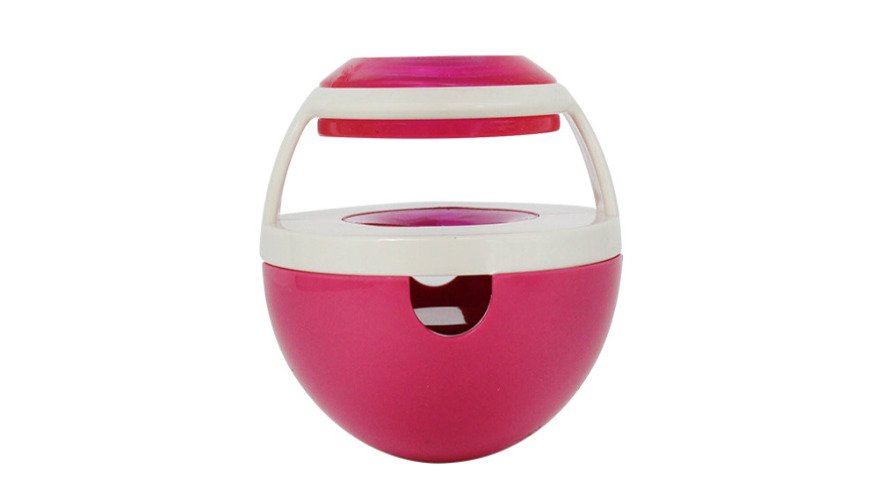
Our Interactive Slow Feeder Toy for Large Dogs is a roll-and-release puzzle ball you fill with kibble or treats. Your dog rolls and shakes it to release them, which encourages slower eating, reduces boredom, and supports mental stimulation. It is made from sturdy, pet-friendly plastic for regular use and measures 8.5 × 8.5 × 9 cm in blue or pink.

Toys for Dogs That Destroy Everything: A Realistic Selection Guide
Toys for dogs that destroy everything need to survive force, not just enthusiasm. If your dog shreds plush toys in minutes, skip fabric entirely and focus on solid, thick-walled designs with no seams to rip.
Here is how we would choose, based on the behavior in front of you:
- Chews to shred: solid rubber or thick plastic, one-piece construction
- Chews to eat: avoid anything that sheds small pieces; check materials carefully
- Loses interest fast: treat-dispensing toys that reward effort
A common mistake is buying one "tough" toy and leaving the dog alone with it for hours. Even durable toys need a rotation. Keep three or four in circulation and swap them weekly so novelty does the work.
How to Test Durability, Clean Toys, and Know When to Replace Them
Most roundups label a toy "durable" and move on. This section explains a repeatable at-home durability test, how to clean different toy materials, and how to calculate cost per use so you can compare toys on something other than the sticker price.
A Repeatable Durability Test You Can Run at Home
A useful durability test has four things: a defined dog, a defined chewing style, a defined time window, and a defined failure point. Without those, "it lasted a long time" means nothing.
Set it up like this:
- Dog profile: note your dog's weight, jaw size, and chewing style (gnawer, shredder, or swallower).
- Session length: 15 to 20 minutes of supervised solo play, once per day.
- Test window: two weeks before you make a judgment.
Run this inspection once a week:
- Squeeze the toy firmly and look for cracks or stress marks
- Run a finger along every seam and edge
- Tug any attached parts to confirm they stay put
If any step fails, retire the toy. Replacement is cheaper than a veterinary visit.
Cleaning by Material
Cleaning is not just hygiene, it is your best chance to inspect the whole surface up close.
- Solid rubber and thermoplastic elastomer: warm water, mild dish soap, scrub with a bottle brush, air dry completely before returning it to your dog.
- Hard plastic puzzle shells: most are top-rack dishwasher safe, but remove any rubber seals or treat doors first so they do not warp or go missing.
- Treat-dispensing toys with internal channels: soak in warm water for 10 minutes, then flush the channel with a narrow brush. Dried kibble residue is the most common cause of a toy that stops dispensing.
Check the manufacturer's instructions before any dishwasher cycle. Heat can deform thin plastic and shorten a toy's life.
Cost Per Use: The Honest Value Metric
Purchase price tells you almost nothing about value. Cost per use does.
Divide the price by the number of weeks the toy survives under your dog's normal play. A $25 toy that lasts a year works out to roughly 48 cents per week.
When you compare two toys, ask:
- Does it have replacement parts, or do you rebuy the whole thing?
- Does it use standard kibble, or a proprietary refill?
- Does it survive a dishwasher cycle, or does cleaning shorten its life?
- Does it hold your dog's interest after the treats run out?
A toy that costs more up front but lasts longer and uses food you already have usually wins on cost per use. That is the comparison most product listings never make.
Frequently Asked Questions
What are some good indestructible interactive dog toys?
No toy is truly indestructible, but the toughest options combine thick, non-toxic rubber or sturdy pet-friendly plastic with an interactive element like a treat cavity or rolling puzzle ball. Look for toys with no small removable parts, a solid one-piece build, and a size rating that matches your dog's weight range. For power chewers, treat-dispensing balls and heavy rubber puzzle toys hold up far better than plush or thin-walled squeakers. Always supervise the first few sessions and remove the toy once it shows deep gouges or cracks.
What is the best toy for a dog that destroys everything?
Dogs that destroy everything usually need a toy that redirects chewing rather than resisting it forever. A durable treat-dispensing toy, like the Interactive Slow Feeder Toy for Large Dogs at $36.95, keeps the dog working for food instead of shredding fabric. Pair it with a tough rubber chew and rotate toys every few days so novelty does not wear off. Match the toy to chewing strength, not just breed size, and check it after every session for wear and tear before it becomes a choking hazard.
Are puzzle toys suitable for aggressive chewers?
Some are, but not all. Puzzle toys built from sturdy pet-friendly plastic or thick rubber can handle strong chewers, while sliding-piece puzzles with thin tabs usually cannot. Check the manufacturer's chew-strength rating and whether any parts can be pried loose. For aggressive chewers, choose puzzle toys with few or no removable pieces and supervise play until you know how your dog interacts with it. If the dog starts chewing the puzzle body instead of solving it, switch to a tougher treat-dispensing design.
How do I choose a durable interactive toy for my dog?
Start with three factors: your dog's weight range, chewing strength, and play style. A dog that gnaws steadily needs thick rubber, while a dog that solves problems quickly needs a puzzle with adjustable difficulty. Then check for safe, non-toxic materials, no small parts that could become a choking hazard, and whether the toy is washable. Finally, compare cost per use, not just price. A $36.95 toy that lasts a year costs less per month than three cheap toys that fall apart in weeks.
Leave a comment